

Thanks, Lynne Jacobs, who heads up this annual practice, along with Jennifer Paget and Betsy Teutsch.
We allocated $3000 from our Treasury, $400 each to 7 grantee organizations and $200 to a local volunteer effort. Our members recommend grantees.
AmericanFriends of Combatants for Peace is a diverse community of U.S. and international activists working in solidarity with CfP to raise awareness and resources, build community, and take direct action to advance the work of CfP for a just peace in Israel and Palestine.
(Several Dorshei members involved with the Philly Chapter.)
Combatants for Peace (CfP) is a joint Palestinian-Israeli community-- guided by the values of nonviolent resistance—that works in solidarity to end the occupation, discrimination, and oppression of all people living on this land.
AmericanFriends of the Parents Circle shares the human side of the Israeli-Palestinian conflict with the American public to foster a peace and reconciliation process. (DD Members are supporters).
The Parents Circle – Families Forum is a joint Israeli-Palestinian organization made up of more than 600 bereaved families. Their common bond is that they have lost a close family member to the conflict. But instead of choosing revenge, they have chosen a path of reconciliation.
FamilyPromise works with Philly families in times of crisis to prevent eviction, find shelter, and provide access to safe, affordable housing. (Many DD/GJC supporters. Led by Rachel Falkove for many years.)
GJC
Refugee Welcoming Team c/o Fed. of Neighborhood
Centers
For work with 2 refugees from Colombia. (many DD/GJC volunteers)
Hand inHand: Center for Jewish-Arab Education in Israel
Fast-growing, integrated social movement, working with thousands of people every day, proving that people can live together as Jews and Arabs, Israelis, and Palestinians. (Dorshei supporters)
Rebuilding Together Philadelphia
Providing free home repairs for low-income homeowners in Philadelphia, with a focus on health, safety, and energy efficiency, allowing for family wealth preservation. (DD supporters and employees.)
A community of women and allies dedicated to achieving global gender equality with hundreds of local chapters across the U.S. (DD supporters; NW Philly groups started by Betsy Teutsch, but NOT her suggestion.)
+
$200 to GermantownCommunity Fridge
Fights hunger and food insecurity. Provides free, supplemental food in
Germantown, Philadelphia. Stocked by the community, for the community, anyone
who needs food is welcome to take it.

From https://www.facebook.com/cdfifriendly :
As #WomensHistoryMonth comes to a close, we want to feature a woman who has been in the Community Development Financial Institution industry since its inception—our very own, Adina Abramowitz! Adina began her career in this field in 1987, working for a new nonprofit small business lender in Camden, NJ, known as CBAC. Today it would be called a CDFI, but the term "CDFI" was not established until 1994.Adina was drawn to the position because of a desire to make a difference and she saw that financing could be a tool to address social justice issues. She was instrumental in the early development of the CDFI industry through her work at Opportunity Finance Network, and in 2006 she launched her own consulting firm to help CDFIs develop and implement transformational strategies.
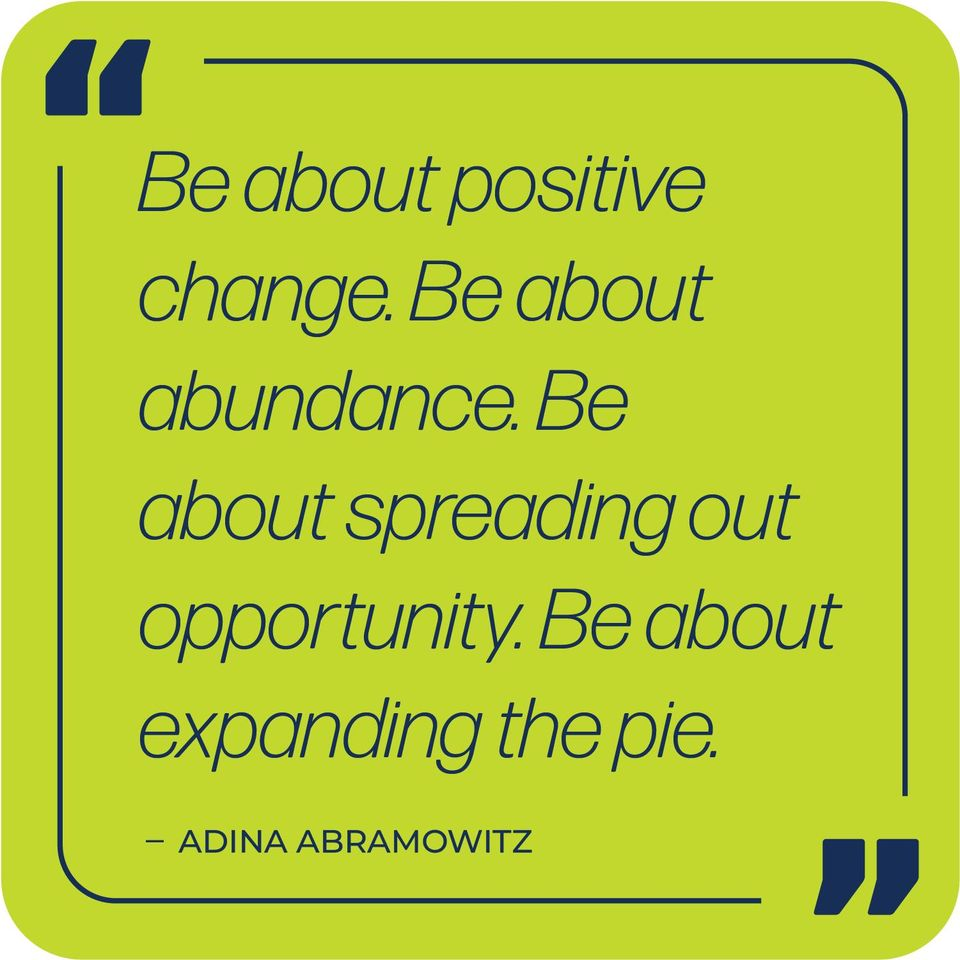
In 2018, Adina was contacted by her former colleague Mark Pinsky to help with a project in Bloomington, IN, which became the 1st CDFI Friendly city and helped form the CDFI Friendly strategy. After years of working with individual CDFIs, Adina enjoys how working at CDFI Friendly America has given her a fresh perspective—seeing and trying to solve for all of the credit needs in underserved communities. We at CDFI Friendly America are very grateful to have access to her wisdom and experience. Her advice to anyone entering the Community Development Finance space, "Be about positive change. Be about abundance. Be about spreading out opportunity. Be about expanding the pie."
צֶ֥דֶק צֶ֖דֶק תִּרְדֹּ֑ף
First, a quick summary of this
momentous parashah. It opens with the 8th
and 9th plagues, locusts and darkness. Pharaoh continues to
refuse to let the Israelites go and worship God in the wilderness. God then tells Moses, and Moses tells
Pharaoh, that there will be one more plague, the killing of the firstborn. There
is then a pause in the drama while God gives instructions for the Passover lamb
sacrifice that the Israelites are to offer that evening, along with unleavened
bread and bitter herbs, and the commandment for the seven-day holiday of
Passover. The Israelites are then instructed to mark their doorposts with blood
to indicate their homes should be spared from the last plague. In the middle of
the night, God kills all Egyptian firstborns, human and cattle. The Israelites
request and receive objects of silver and gold from the Egyptians, as God had
told them to. And they leave Egypt, baking unleavened cakes on their way out. Moses
repeats the rituals of the Passover holiday for the people to follow when God
leads them into the land God promised to their ancestors, along with the redemption
of firstborn children and animals.
Looking at this week’s parashah
through an anti-racism lens, it is not hard to find teachings that can
inform and inspire our present-day quest for racial justice.
First, the liberation of the Israelites from slavery in Egypt
has been a powerful inspiration for liberation movements over the generations,
and has been especially potent for the African American struggle for
liberation, first from slavery, and subsequently from continuing oppression. We
can find in today’s parashah a precedent for the layers of oppression that
Black Americans have faced in their quest for liberation. Moses starts by
asking for the Israelites to be able to go and worship God in the wilderness.
At first Pharaoh says no, then is persuaded by the plagues to say: OK, worship
your God, but here in Egpyt, not in the wilderness. Then he says OK, go to the
wilderness but only men, no children. Then he says OK all the people, but no
cattle, before he is finally convinced to allow all the people and their
animals to leave. Even after the Exodus, Pharaoh changes his mind and tries to
recapture the Israelites.
These reluctant insufficient steps toward liberation are echoed in the Black American liberation experience. The United States’ Pharaoh, the white power structure, eventually and reluctantly ended chattel slavery, but soon replaced it with the practices of Jim Crow: OK, you can be technically “free”, but you can’t vote, can’t receive an education, can’t own property, etc. Eventually the U.S. Pharaoh said OK, we’ll eliminate explicitly racist laws, but maintain racial segregation and discrimination through practices like redlining and restrictive covenants, and restricting economic opportunity. In the next phase, commonly termed the “New Jim Crow”, Blacks were and continue to be targeted with differential law enforcement, resulting in mass incarceration and ongoing disparities in access to education, economic opportunity, and power.
Secondly, also in
today’s parashah is the precedent for reparations for slavery. It is first commanded in Exodus 11:2-3:
Tell the people to borrow, each man from
his neighbor and each woman from hers, objects of silver and gold.
The LORD disposed the Egyptians favorably
toward the people. Moreover, Moses himself was much esteemed in the land of
Egypt, among Pharaoh’s courtiers and among the people.
And then it is carried out in Exodus 12:35-36:
The Israelites had done Moses’ bidding and
borrowed from the Egyptians objects of silver and gold, and clothing.
And the LORD had disposed the Egyptians
favorably toward the people, and they let them have their request; thus they
stripped the Egyptians.
The word “borrow” can
alternatively be translated as “ask for”.
The Book of Jubilees (an ancient
Hebrew text that did not make it into the Bible) says: “This asking was in
order to despoil the Egyptians in return for the bondage in which they had
forced them to serve.”
The medieval commentator Sforno
says: In Moses' honor the Egyptians gave generously to the Israelites.
It is fascinating how the Plaut
Torah commentary, published by the Reform movement in 1981, tersely comments on
these verses: “Note also the demands for restitution made by the black
revolutionary movement in the United States.”
Thirdly, there are different models of bringing about
justice. How does God bring Pharaoh
around to the right point of view? From
the opening verses of today’s parashah:
You may recount in the hearing of your
child and of your child’s child how I made a mockery of the Egyptians . . . How
long will you refuse to humble yourself before Me?
This is a model of total
domination and humiliation, which was deemed necessary in the face of Pharaoh’s
arrogant and repeated hard-hearted refusal to let the Israelites go. Is there
another model for opening people to a just perspective?
There is a classical midrash in
which Pharaoh is spared at the Red Sea, and ends up leading his people in
repenting. In the Midrash, Pharoah became king of Nineveh, where, hundreds of
years later, Jonah came and brought word from God that in three days Nineveh
would be destroyed because of its wickedness. Pharaoh remembered when Moses
brought God's word that Egypt was doomed. So this time, he listened and led the
people of Nineveh in repentance. The wording in the book of Jonah, “The people
of Ninveveh believed in God”, mimics that in Exodus right before the Song of
the Sea: “They believed in God”. The people of Nineveh were brought to belief
in God by none other than Pharaoh, when he told them of the wonders that
occurred in Egypt and the Red Sea. The fact that someone like Pharaoh, who time
and again refused to recognize the power of God, could repent and teach a whole
city about the truth of God, is a remarkable lesson in the strength of
repentance.
I want to invite us to explore
how we approach our anti-racism efforts. Do we emulate God’s approach in Egypt
of blaming and humbling those who perpetuate racism? Or do we emulate God’s and
the king of Nineveh’s approach of inviting people into repentance? While there
may be times in the struggle for racial justice that require strong public
rebuke, for the work we are doing inside our own GJC community, I invite us to
proceed with compassion, love, and respect.
All of us grew up in a society
steeped in racism, whether or not we were aware of it. None of us asked for
this, but none of us could avoid messages of white supremacy and Black
inferiority from seeping into our conscious and unconscious minds. It was the
air that we breathed, and we are not to blame for having those attitudes and
thoughts lurking somewhere inside us. As I see it, our challenge is to uncover
any unconscious racial bias we harbor, strive not to let it influence our
thoughts and actions, and work to dismantle the oppressive systems that
centuries of racism have built up.
How can we approach our
anti-racism journey as a cooperative venture? As a way to help each other
liberate ourselves from the dehumanizing effects of racism? All of us have
blind spots, and we need each other to help see them. I believe that is best
done with compassion rather than blame, shame, or guilt. With a loving
approach, we can support each other to overcome our defensive reactions, and
maybe even celebrate anytime an artifact of our racist conditioning comes to
light.
The big sign on the GJC lawn near Emlen Street says “Black
Lives Matter” on one side. The other
side sometime reads “Tzedek tzedek tirdof – Justice, justice – pursue it.”. Why
does this verse from Deuteronomy repeat the word justice? To teach us to pursue justice in a just
way. I believe the just way to fulfill
our goal to be an antiracist community is to approach each other with
compassion.
Stefan’s presence in our minyan intensified along with his illness. He was a husband to Sandy and father of their three young kids [adults, and all present tonight!], in his late 40s, when diagnosed with a brain tumor. His prognosis was not great. He had been a member of Dorshei Derekh for several years, but once ill, he came to Dorshei Derekh most every shabbat, often sharing where he was on this distressing journey. When he had to stop working, and his world became smaller, the times he spent with us became increasingly precious. He radiated love, and we all beamed it back at him. Many of our members regularly went to visit with him as he became more frail.
He died on Shabbat Shuvah, the Sabbath between Rosh Hashanah and Yom Kippur, in 2005. A few of us organized a program on his 2nd yahrzeit. His dear friend Professor Seth Kreimer spoke on legal issues issues of the day.
My memory is hazy on how we decided to repeat this annually, but I recall meeting up with David Mosenkis at High Point to kick around ideas. Stefan had been the Legal Director of the Pennsylvania ACLU and many Minyan teens interned for him. Inviting them to speak was a way for us all to process both the loss of Stefan, and nurture his legacy. We got to hear what work Ari Spicehandler Brochin, Josh Marcus, Frances Kreimer, and our son Zach Teutsch, were up to. They are all active in social justice work as adults.
By 2010 our planning group included Donald Joseph. In Stefan’s memory we planned an annual program on a specific social justice topic in the late fall/early winter. While the GJC community was always invited, it has primarily been an internal Dorshei Derekh event.
Our formula was to choose an issue we wanted to learn more about, invite an expert activist to speak, and pair them with someone with substantial Jewish insight on the topic. Adding a lunch or, as we called it, lunchy kiddush, encouraged people to stick around. This was our approach for the ensuing decade, pulled off on a shoestring, funded by our minyan treasury.
In the ‘0s, Germantown Jewish Centre’s social justice portfolio resided in the Social Action Committee. This committee was tasked with the annual MLK program done in conjunction with local churches, through the Neighbourhood Interfaith Movement. They also planned the annual Granger Shabbat focusing on local social justice issues. Additionally, the committee focused on direct service, organizing volunteers for tutoring and Story Times at our neighborhood’s Henry and Houston Schools. GJC’s program for housing and feeding homeless families, the Philadelphia Interfaith Hospitality Network, began in 1996, a complex undertaking with its own team of in-house volunteers. It became a major focus of direct service GJC mitzvah activity.
What was missing at GJC was a way for members with a passion around a particular cause to organize and build support for shared activism. We have always had many members involved in a myriad of issues. In our minyan Stefan brought his ACLU background; Mike Masch z”l was our pipeline to city politics, as well as to Harrisburg and Pennsylvania state government policy and budget. It’s not every minyan that offers a misheberach when the State Budget passes!
Many of our Stefan Presser program topics were proposed by Dorshei Derekh members wanting a platform for causes in which they were already immersed. Malkah Binah Klein became our committee chair, and brought some specific programs, including the one on Gun Violence and another on Returning Citizens. On some level, we used this Social Justice annual program as an incubator; quite a few of the topics grew into synagogue-wide concerns.
In 2016 the GJC Social Action Committee was restructured as the Tikkun Olam Coordinating Team. One of those working to bring about this change is our own Abby Weinberg. The mission is now very different, supporting members to advocate and organize for the causes they care about, and running programs where congregants can get involved. Tikkun Olam means Repairing the World; clearly we have continued providing direct services to but have expanded to working for systemic changes.
And we will be hearing Donald Joseph’s update on the Pennsylvania School Funding Trial, the culmination of decades of work by the Public Interest Law Center.
David Mosenkis will be talking in a few minutes about the synagogue’s deepening commitment to POWER, a state-wide multi-faith multi-racial movement advocating for systemic change in a number of arenas.
We will be hearing from Seth Lieberman, the chair of the synagogue-wide Refugee Committee.
We will be hearing from Tamara Cohen, on the minyan’s antiracism task force, along with hearing about the synagogue’s.
These are all topics that we featured at specific Social Justice shabbatot, and are now woven into our synagogue’s work.
Personal activism and community organizing have taken off exponentially since the beginning of our Presser Shabbatot in 2008. The language around this work has changed. We have moved from Social Action to Social Justice to Tikkun Olam. We are now more nuanced about justice: we speak of racial justice, environmental and climate justice, reproductive justice, education justice, disability justice, and gender justice. Kol Tzedek, the Reconstructionist Congregation in West Philly where many GJC Gen Xers are active, including Josh Marcus, named itself Kol Tzedek, A Voice for Justice - right there, front and center. There are many similar synagogues around the country that have sprung up with a primary focus on Tikkun Olam.
Obviously, the 4 years of the previous administration raised the pursuit of social justice to a crisis level. And 2 years of a pandemic have reset most everything.
The Jewish community has generated ever more justice-oriented organizations. Keeping track of all of them is challenging!
Tonight we are reflecting on how social justice/Tikkun Olam moved from the periphery of Dorshei Derekh - something some of our members were devoted to - to becoming a central focus of our community. And how Dorshei’s Derekh commitment to these values connects to GJC, our larger home.
We cannot claim that our Stefan Presser Social Justice programs brought this about, but we immodestly perhaps, do think they have helped to galvanize Dorshei Derekh, and motivated many of us to get more involved in initiatives we learned about at these programs. Indeed, we are better together. Pursuing justice is more effective, and more satisfying, when it’s a shared effort.
- Betsy Teutsch, January 29, 2022

 |
Kippah Crocheter Angelica Marta works
her family. Photo: Dina Tanners
|

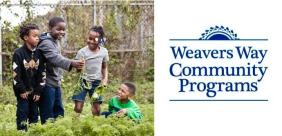 y Community Program, the community garden at Stenton Family Manor, a homeless shelter in Germantown. The grant helps a farm educator teach residents how to raise food. The produce raised is used directly in the kitchen to feed residents.


