Showing posts with label members of DD. Show all posts

Tuesday, November 14, 2023

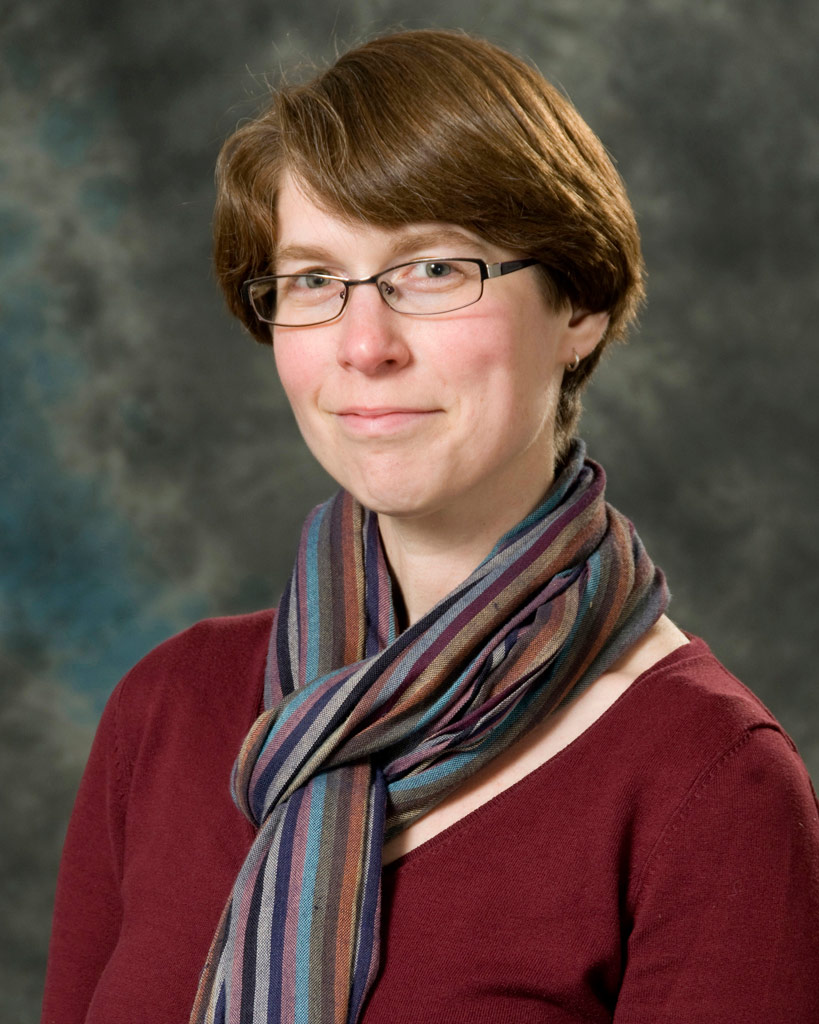
Yasher Koach to Rabbi Tamara Cohen, Covenant Grant Winner 2023


Congratulations to our own Rabbi Tamara Cohen, recipient of the Covenant Foundation Award. Here is her talk, presented on November 8, 2023:

Hineni, here I am, Tamara Rut bat Esther Rachel v’ Shachna Pinchas, Zichrono Livracha.  

Hineni, here I am, a Jewish feminist educator, nurtured by beloved mentors and community and passionately committed to transforming Jewish education by centering the experiences of Jewish women and girls, LGBTQ+ Jews and Jews of color.

My work is the weaving together of ancient and new, the grafting of tradition and innovation, the invitation to others to join me in sacred play and holy community building. I gather and create texts, ideas and rituals that have been rescued, excavated and revealed to us by Jewish feminist historians, theologians and scholars and I offer them to Jewish young people, their parents and educators, as keys, as pathways, as doors inviting our youth, especially those who feel on the margins, to come inside, to make themselves at home in Judaism, a richer, more multifaceted, more whole Judaism that with their presence and creativity, can and truly serve as a home for all of us in our diversity.

Jewish feminism starts by recognizing the vibrant Jewishness of women but it doesn’t end there. It challenges structural inequity, asks us to re-think our core assumptions, dares us to name what is sacred in ourselves and in every being we encounter with ancient and new language.

Jewish education grounded in feminism is a practice of hope. Born of necessity, loss, exclusion, oppression, revolution, it invites us all to hold complexity, to dream that more is possible, and to trust that we have and can create the tools we need, even for this intensely challenging moment.

We have practices of empathy and listening, midrash, ritual and Torah study. We know how to honor each other’s experiences and embrace each other’s questions, how to hold ourselves and others accountable, how to walk the path of teshuva, how to envision justice and enact compromise, how to cultivate the courage for the hard work of collaboration and connection across difference, how to praise and cry out to God using Her many names.

The Israelites in the desert are said to have been sustained by Miriam’s Well. Perhaps it was the same well that Hagar saw when God opened her eyes in her moment of despair. That ancient mythical well is what I want to help our youth see, drink from, and when needed, help us refill. It is a well of sustenance, healing and hope.

Jewish youth need us to walk with them into the pressing questions and challenges of our era as guides and as partners. They need us to be honest, brave, and moral cultivators of hope even as we take seriously the threats we face. They need us to see in them what they can’t always see in themselves or in one another.

Hineni, here I am. Filled with gratitude and ready to answer the ongoing call to teach, to lead, to widen the tent, to insist on a third way, to do justice, love goodness and walk humbly with God.


The Covenant Foundation's Covenant Award, honor three exemplary Jewish educators who are each meeting a complex moment in Jewish communal history with a powerful blend of courage, commitment, and compassion.

The 2023 Covenant Award recipients are: Rabbi Tamara R. Cohen, Chief Program Officer, Moving Traditions, Philadelphia, PA; Allison Cook, Founder and Co-Director, Pedagogy of Partnership, Powered by Hadar, Cambridge, MA; Nicole Nash, Head of School, Hannah Senesh Community Day School, Brooklyn, NY.

Thursday, October 19, 2023

Parshat Bereshit - by Rabbi Ellen Bernstein - 2023/5784


Bereshit, Genesis I
, by Rabbi Ellen Bernstein www.ellenbernstein.org

Friends,

I want to apologize first for not giving a d’var related to the tragedy in the Middle East. Bereshit comes around just once a year and I’ve been waiting 2 years to give this d’var, since the slot was already taken last year. However, wrapped up in this d’var—but perhaps not so explicit—is the resilience of the natural world, so I hope that in this time of great sorrow, she can whisper some measure of comfort to you.

My decision to take Judaism seriously and my entire career in the field of religion and ecology is a result of my first encounter with Genesis 1 as a young adult. In college in the 70’s, I studied in one of the first environmental studies programs in the US at Berkeley. Science seemed like only part of an answer to our environmental crisis, so I also embarked on a spiritual search that led me to studying the parsha with a friend; Having no prior relationship with the text, I was stunned to find such an elegant environmental manifesto in this very first chapter of the Bible.

In case you have never studied this chapter before—a brief overview. God creates light on the first day, divides up air and water on the second; earth and trees appear on the third, stars and planets on the 4th, swimmers and flyers on the 5th, land animals and people on the 6th ; and on the 7th, God rested, creating Shabbat. In an elegant design the habitats/elements of air and water on day 2 and earth on day 3, give rise to their inhabitants--the air creatures and water creatures on day 5, and land creatures on day 6. If you plot out the creations of the days, you will see this simple and orderly design.

Goodness

Significantly, God sees everything that comes into being as “good.” In Genesis 1, the goodness of the biodiverse world is the pre-eminent value. Each creature is inherently valuable—each has value in and of itself—whether or not we humans deem it useful or valuable. The rabbi, philosopher, physician Maimonides, writing in the twelfth century, said that the goodness of all the creatures is a testament to their intrinsic value. Each organism has integrity, each contributes to the whole and is required for the whole. The world is built on the foundation of the goodness of the creatures, without which it could not exist.

This alone is a fundamental ecological idea, but there are several more that permeate the text.

The centrality/agency/meaning of Earth: Eretz

Go to Gen I.11; The idea that the Earth is alive in some way—is a second fundamental ecological idea in Genesis 1. Many environmentalists argue that our environmental problems are rooted in our haphazard treatment of the earth. Since we don’t regard the earth as alive or life giving, we can innocently exploit and pollute her with no thought of the damage we may be inflicting or the consequences of our lifestyles. The scientists James Lovelock and Lynn Margulies understood earth as a self-regulating living system and called this idea the Gaia hypothesis—after the Greek goddess of earth, Gaia, mother of all life. This was considered a radical idea in its time about 50 years ago. And yet Genesis I portrays the earth as the mother of life, generating life, centuries before Lovelock, but most of us don’t recognize the aliveness of earth in the Bible, just like we don’t recognize the aliveness of earth beneath our feet. The construction of the Hebrew in verse 1:11 points to her lifegiving nature. On the third day, the text proclaims, “Let the earth bring forth vegetation.” The earth here has agency; she partners with God in the “bringing forth.” The earth has the ability to grow the creatures that will inhabit her. She is prolific. She is alive. We see this unusual construction again on the sixth day when the earth partners with God to bring forth animals. The 12th century rabbinic commentator Nachmanides recognized the aliveness of the earth, stating that the very word for earth, eretz, suggests a force that causes growth.

Its worth noting as well that the word eretz occurs 10 times in the creation story—a kind of magic number—again highlighting her significance.

Sustainability


Third, the ecological idea of sustainability or flourishing appears over and over throughout Genesis 1. Sustainability is communicated in several ways—first, through the attention to seeds, or zera, given on the 3rd day in Genesis 1:11-12. Most people familiar with the creation story will tell you the third day is all about the trees and vegetation, and while all this green growth is incredibly significant, what is actually emphasized on day 3 is the word zera or seed. Zera, in various forms, is repeated 6 times in these 2 verses, telling us to pay attention; seeds are significant. The plants will seed seeds and fruit trees will make fruit with seeds in them. Seeds are, after all, the way that life is able to sustain and diversify itself from one generation to the next; This is what the biblical author seems most eager to convey on the 3rd day.

Sustainability is also communicated through the phrase “after its kind” used repeatedly throughout Genesis 1 after almost every creature is created, pointing again to the biblical regard that life must be able to perpetuate itself.

The concept of blessing is another way in which the sustainability—the perpetuation of the species line—is articulated in Genesis 1. Most people assume that the Torah’s first blessing was given to humans—but in fact it is given to the fish and the birds. Take a look at verse 1:22 . God blesses the flyers and swimmers with the ability to be fruitful and multiply.

With so many references the idea of living beings reproducing themselves, it’s clear that the biblical author was concerned—perhaps first and foremost—with the perpetuation of life on earth. The first creation story concludes with Genesis 2:3, and those of you who are facile with the Hebrew should be able to find a clue that this whole story ends with yet another declaration of the significance of sustainably. We can come back to this later if we have time.

Very Goodness=Kol

One more ecological idea that I want to mention today comes at the conclusion of the 6th day. While on all other days, God sees each creation as good, on the sixth day, God makes a proclamation that God’s creation is “very good,” tov maod. Without looking at the text, what category of creation do you imagine is called “very good”—or lets’ say, what would most people who have not studied the text say?

Verse I:31 clearly declares: And God saw everything –kol—that God had made and behold it was very good. Each individual creation was called good and now all the creatures, everything altogether is deemed “very good.” The repetition of the two-letter word kol or everything seven times in verses 29 and 30 evinces the importance of all the creatures, all together. There is a sense of indivisibility of all the creatures involved as one living breathing whole. Every organism is bound up in the life of every other organism.

Commentators and many readers of the text have long presumed that the designation of “very goodness” on the sixth day referred to the human creatures who were created on this day. They assumed that humanity was the crown of creation, and that the creation was established solely for people to use for their own benefit. Such an assumption leads to a utilitarian and anthropocentric stance towards the world. Curiously, human creatures, unlike all the other animals, do not receive the designation of “tov.” From the beginning, the biblical author was circumspect about humanity. Indeed, the midrash teaches that God consulted with the angels to determine whether or not to even create human beings. (Bereshit Rabbah 8:8).

There’s more I can say about Genesis 1’s ecological vocabulary (I wrote a whole book on it 20 years ago: The Splendor of Creation) but I want to make sure to leave plenty of time for a discussion of humanity’s role Genesis 1:28. Perhaps—if you are familiar with the text, you will recall that when humanity was created—last after all the rest—God gives them mastery over the earth and dominion over the other creatures. Read Gen 1:28.

In 1969, the historian Lynn White wrote a famous article in Science Magazine, “The Historical Root of the Ecologic Crisis,” blaming the Bible and the Judao-Christian tradition for our environmental crisis: He claimed that God’s giving humanity dominion meant that God gave humanity a mandate to dominate and exploit nature. This has become a very common reading in liberal and environmentalist circles, including among environmentalist rabbis.

For example: The esteemed Israeli soil scientist and irrigation expert, Daniel Hillel, (author of The Natural History of the Bible and many other books) referring to Genesis I:28 wrote, “His [the human’s] manifest destiny is to be an omnipotent master over nature, which from the outset, was created for his gratification. He is endowed with the power and right to dominate the creatures toward whom he has no obligation.”

There are legitimate reasons that so many people are suspicious of Genesis 1.28. The idea of dominion as domination has endured a long and dark history that has led to terrible suffering and disastrous consequences. The verse was appropriated by the pope in 1493 to justify the Doctrine of Discovery and legitimize the confiscation of native lands everywhere. Tragically, this ideology persists.

Lynn White’s assumption that the Bible—and the idea of dominion—was responsible for the environmental crisis had a profound effect on a whole generation of environmentalists and their students and it had a profound effect on me. It caused me to question how Judaism understood our relationship with the natural world. Yet once I began studying the parasha with a friend, I realized pretty quickly that those who argue that dominion means domination take the verse out of context, paying no attention to the verses that precede or follow this one. Many of them are biased against the Bible to begin with.

If you read the context of this chapter, as we have been doing, you might ask, as the farmer poet Wendell Berry did, “Why would God want to give humanity a mandate to exploit nature after God worked so intentionally to create such a beautiful world”— a world that could sustain itself on its own in perpetuity, without any interference from people?

The Bible itself hints that dominion is not given to people arbitrarily. It appears that dominion is conditional as it certainly is later in the Bible. Dominion is given and can be taken away. The Hebrew word for dominion, RDH, points to this conditionality. Since Hebrew words are built on a system of three-letter roots, and one root can lend itself to multiple meanings, sometimes even a word and its opposite share the same three-letter root.

In certain grammatical forms (in the imperative form and the plural imperfect for 2nd and 3rd person) RDH looks exactly like another Hebrew word, YRD “to go down.” When RDH appears in one of these ambiguous forms as it does in Genesis 1:26, you must determine the word’s meaning by its context. Rashi, the foremost medieval rabbinic commentator, points out the wordplay inherent in this 3-letter root and explains that if we consciously embody God’s image, if we stand up-right and rule responsibly with wisdom and compassion, we will RDH, have dominion over, the creatures, insuring a world of harmony; but if we are deny our responsibility to the creation and thoughtlessly take advantage of our position and the creation, we will YRD, go down below the other creatures and bring ruin to ourselves and the world.[1] If we upend the blessing to further selfish goals, the blessing becomes a curse. If dominion becomes domination, then we are no longer worthy of the role we have been bestowed. We lose our kinship with God, and we lose our kinship with earth.

Significantly dominion is bestowed as part of a two-fold blessing or bracha. The word bracha in Hebrew is related to the word beracha, a pond of water. A blessing is enlivening and regenerative, like an oasis in the desert. The blessing in verse 1:28 is for both fruitfulness and dominion. It lays the foundation for the two basic necessities of life. Fruitfulness promises generativity of the body and dominion—through the human creature’s benevolent rule—promises generativity of the earth and its creatures. Barrenness of body and barrenness of land (famine) would be the greatest threats to the Israelite people, while fruitfulness in both would be the greatest gift. The two-fold blessing for fertility and land reverberates through the Torah in the promise that God makes to Abraham, Isaac and Jacob and the Israelites.

Notably the verses that follows add further context to the meaning of dominion. Immediately after God grants dominion to the human creature, God assigns the seed plants for food for the humans, and the leafy greens for the animals. Dominion, then, ensures that not just people, but that animals too, can eat and thrive. Notably, dominion over the animals does not include the right to eat them.

Some of the rabbinic sages, read dominion allegorically and suggested that people must have dominion over their own desires, and master the tendency towards gluttony. Dominion over the earth first requires dominion over our selves. Seventy years ago, the great environmentalist Rachel Carson eloquently wrote "We, in this generation, must come to terms with nature. We're challenged as [hu]mankind has never been challenged before to prove our maturity and our mastery, not of nature, but of ourselves."

There’s much more to say about all of this and I’m happy to refer you to resources if you are interested.

I want to conclude by saying that I always had this idea that Genesis I is an overture to the whole bible. You know the book, “Everything I need to know, I learned in kindergarten,” That’s how I feel about Genesis I.

I always intuited that if Genesis 1 offered such a profound ecology, that these ideas must—like invisible mycelia--undergird the whole Torah, but I had never heard any Jews talk about a creation theology before—Creation theology isn’t even a thing in the Jewish world. If anything, the very language of creation is off-putting to most people I know. Mentioning creation theology in certain circles, and people assume you are a fundamentalist. There are many reasons that these ideas haven’t found their way into contemporary Jewish thought, but that’s a conversation for another time.

Questions for discussion:

Are there certain ideas in Torah that you recognized as an adult that have caused you to change your mind about something? In other words, have you had an insight from the Torah as an adult that caused you to change your mind and your behaviors?

Is there a time when you changed your mind to take a new position on something? Want caused you to change your mind?

How are you influenced by ideas? In what way do they affect your life?


[1] Rashi, Commentary on Genesis I:26

Monday, April 3, 2023

Adina Abramowitz: Community Development Finance Mighty Woman


From https://www.facebook.com/cdfifriendly :

As #WomensHistoryMonth comes to a close, we want to feature a woman who has been in the Community Development Financial Institution industry since its inception—our very own, Adina Abramowitz! Adina began her career in this field in 1987, working for a new nonprofit small business lender in Camden, NJ, known as CBAC. Today it would be called a CDFI, but the term "CDFI" was not established until 1994. 

Adina was drawn to the position because of a desire to make a difference and she saw that financing could be a tool to address social justice issues. She was instrumental in the early development of the CDFI industry through her work at Opportunity Finance Network, and in 2006 she launched her own consulting firm to help CDFIs develop and implement transformational strategies.

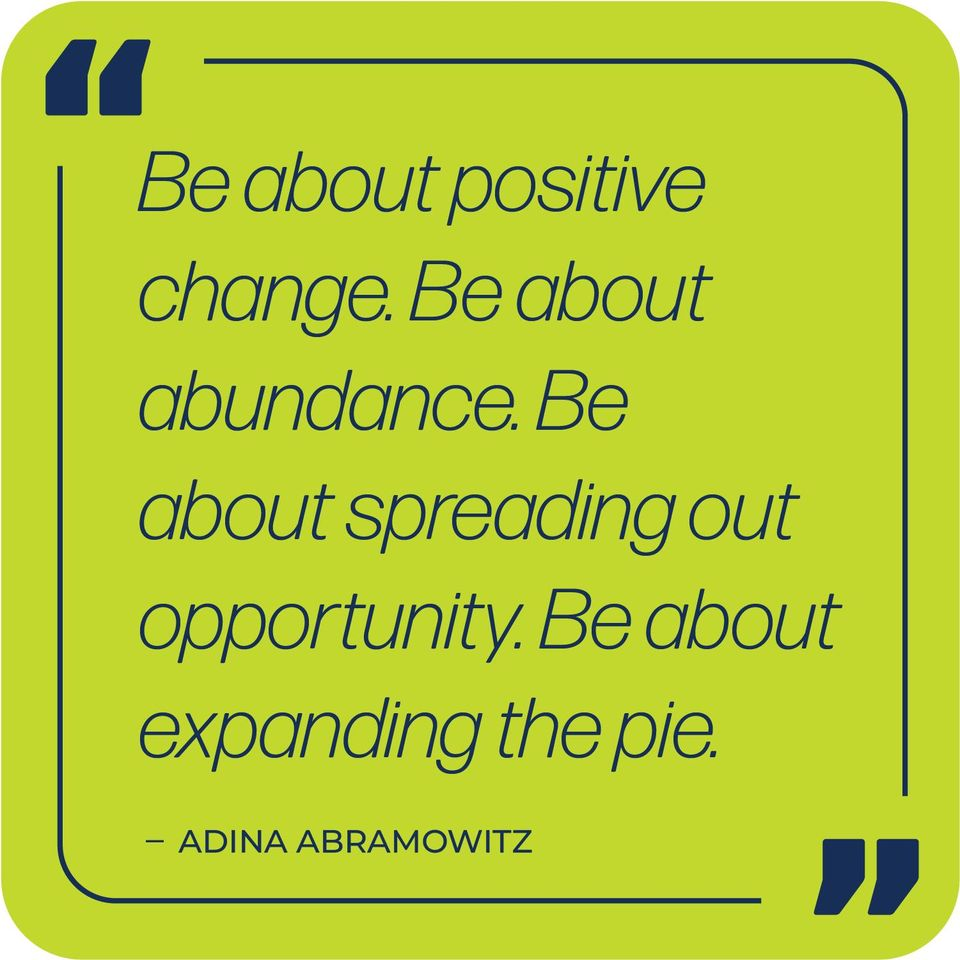
In 2018, Adina was contacted by her former colleague Mark Pinsky to help with a project in Bloomington, IN, which became the 1st CDFI Friendly city and helped form the CDFI Friendly strategy. After years of working with individual CDFIs, Adina enjoys how working at CDFI Friendly America has given her a fresh perspective—seeing and trying to solve for all of the credit needs in underserved communities. We at CDFI Friendly America are very grateful to have access to her wisdom and experience. Her advice to anyone entering the Community Development Finance space, "Be about positive change. Be about abundance. Be about spreading out opportunity. Be about expanding the pie."


Wednesday, September 27, 2017

Cemeteries and Fragments: A Yizkor Kavvanah by Rabbi Robert Tabak

This kavanah was presented by Bob at Passover Yizkor 2017. It is up at his blog Light Amidst Doubt.
A few days after the news of the vandalism to Mount Carmel cemetery in Northeast Philadelphia, I was there as a rabbi aiding the multi-faith cleanup efforts.  There were Jewish volunteers from many neighborhoods and congregations, Muslims, and Christians.  Of course there had been vandalism.  But part of the story was obscured by the focus on antisemitism.  I worked with volunteers pulling inches of dirt and feet of weeds off of long-fallen and sometimes partially buried tombstones, some broken.  These had not been damaged in the last week.  One of the less-publicized aspects of the clean-up was that some of the volunteer teams had been assigned to try and catalogue the names and locations of every one of the graves. No registry could be found.  Laws about cemeteries in Pennsylvania, which like this one can be privately owned, are notably lax. This was a neglected cemetery, with almost no care or records in recent years, from what I could observe.  Yet each of these stones represented a story, a life, a fragment of a journey of our people.
A few weeks later I was in Barcelona.  Some parts of the old Jewish quarter (Call) can still be seen in the old Gothic Quarter.  My wife Ruth and I took a Jewish walking tour, and the guide pointed out the clearly visible pieces of Hebrew gravestones imbedded in various medieval walls.  After the Jews had been expelled in 1492, their cemetery was destroyed and stones re-used for buildings.  The renewed Jewish community and historians have located the medieval Jewish cemetery and have had it designated an historic site, with a monument.  Again, the Jews scattered, but every stone was a story, each fragment a fragment of a life.
I was reminded of a scene in a recent documentary film about modern Poland.  In one small town, a young Catholic man in his thirties was researching the history of the vanished Jewish community – which did not make him popular.  He found many stones from the Jewish cemetery used as paving stones and in building foundations.  He removed those stones and brought them back to the site of the cemetery. In the film, the young man made a trip to Israel, with photos and maps, to consult with an Orthodox rabbi – a setting he did not usually enter. The Orthodox rabbi probably did not often meet with young Catholics, either.  The question the young man asked was having recovered these tombstones, would it be disrespectful to erect them upright in the cemetery, since no one knew exactly where they had stood in 1939.  He wanted to do the right thing.  The rabbi approved, and said this project would honor the dead. (The film was Shtetl [1996] by Marian Marzynski, and the town was Bransk.)
This reminded me of the midrash about the fragments of the first tablets, broken and no longer legible, also being honored and carried by the Israelites. (BT Bava Batra 14b.)   
Sometimes we have whole stories.  Sometimes we have memories of our parents, children, siblings, grandparents.  But there are also generations who came before them, people whose names we do not know, but whose lives and sacred journeys are part of our Jewish story. Sometimes we have only fragments. We also honor them along with the broken graves and stones.
This article originally appeared in the April 2017 issue of the RRA Connection newsletter, publication of the Reconstructionist Rabbinical Association, which I edit.  Reprinted by permission.

Thursday, October 6, 2016

Debbie Stern and Elana Shaw: Mother-Daughter Welcome Team!

Anndee Hochman, For The Inquirer

Elan Shaw, left, and Debbie Stern, right
When Debbie Stern and her husband were first married, Friday night meant a kosher dinner prepared in their fifth-floor walk-up on Manhattan's East 89th Street, a turn-of-the-century apartment with a bathtub in the middle of the kitchen.

Amid religious disaffection, mother and daughter make it life's work to keep the faith
By the time Stern's daughter, Elana, was a teen, the family had decamped for Valley Cottage, N.Y.; there, Shabbat evening meant a challah from Rockland Bakery, an argument about whose turn it was to light the candles, and a twinge of adolescent annoyance during the parents' customary blessing of the children.

"I remember my mother wanting to put her hands on my head, and I didn't want her to," Elana Shaw says.

But the rebellion was short-lived. Today, this mother and daughter are not only observant Jews, but professional Jewish educators whose choices run counter to a widespread trend of religious disaffection.

According to a 2013 Pew Research Center survey, one in five Jews describes him or herself as having no religion, and 62 percent say being Jewish is mainly a matter of ancestry and culture. Among Jewish respondents who have married since 2000, nearly six in 10 have non-Jewish spouses.

Monday, June 13, 2016

Jacob Staub's Op-Ed: Spirituality Contributes to Contented, Meaningful Life

Enjoy Jacob Staub's op-ed "Spirituality Contributes to Contented, Meaningful Life" in the Philadelphia Inquirer:

'Humans plan, and God laughs."
This Yiddish proverb is not as impious as it might seem at first glance. It declares succinctly an undeniable truth of the human condition: We are not in control. No matter how meticulously we plan, there are innumerable variables for which we can't fully account.
Often enough, we plan, and things turn out the way we want. And then we are tempted to believe that we are in control after all.
Our behavior certainly affects outcomes. If I consistently consume fewer calories, there is an excellent chance that I will lose weight. If you treat another person with kindness and compassion, you are far more likely to make a friend than if you are cruel. If your work performance is skillful and conscientious, your job security is likely to increase.
But not necessarily.

Thursday, November 20, 2014

Randall Miller's Profound Responses to the Har Nof Horror


I was not part of the Har Nof community. My daughter and I were immersing ourselves in the warm love of family, and “Toirah" on our final days in Eretz Yisroel. The close knit community of observant Jews worked well together, in prayer, in babysitting, in sharing a close life in the crowded but comfortable concrete apartment buildings built several decades ago. Amongst these building blossomed lovely Houses of study and prayer. While the community made do with common place if not meager personal belongings and furnishings, their holy places, and their ritual items such as prayer shawls and tefillin were the best that could be obtained. There was ongoing celebration of the sanctity of life, lifting the mundane acts of hand washing and eating into holy acts of offering and receiving. 

From the outside this had always been to me group of “black hats” with side locks, covered women with flocks of children, isolating themselves from the secular world in pursuit of the Divine who infuses everything. From the inside, I was experiencing deep love of family, of community, in the process of healing the World in the only way they knew— through prayer, through study, through acts of loving kindness— every moment of every day, from sun up to sundown from birth throughout life. 

I accompanied my cousin to the houses of worship each day, where we prayed and studied. I blessed and was blessed. I saw the love in the eyes of the young and old who welcomed me wrapped in the shawls and strappings of our faith. For a liberal Jew of the secular world this was full immersion. I felt inadequate to the task as i stumbled over my prayers, and remembered rituals. I was lovingly helped with the finer details of service to the One in humility by rabbis and students. I am loved by an unending love. I am held by a spirit that runs deep through our tradition that I have only scratched the surface of in my 60+ years of living.
Binyamin stayed home for 7am services on November 18th to see me off. I praise God that he did. The sirens went off at 7:10am. A synagogue was invaded during prayer and lives were cut short by terror and horror. Each person is an entire universe, each death signals the end of a personal world on earth, and another deep wound that spreads through the community in ways that we shudder to imagine. My personal family is safe, for the moment. Praise the One for the “coincidences” of the day, the week, the chance meetings. We are here to bear witness, to pick up the pieces, to tremble with awe, and cringe with wrenching pain in the events that have enmeshed us all. 

This in not a new scenario for Jews; it is an age old story. It is a story of many people be they Palestinians, Armenians, Tutsis, Sunnis, or Native Americans. And for our people it is a recurring horror story that unfolds through the ages. I do not place my grief above others. But I am enfolded in it. I am now part of the Har Nof community. I grew up with stories. Now I am living them. I now bear witness to the supreme tragedy of man’s hatred for man. How do I process this? How do we process this? We are told to Teach Peace, and to pursue Justice. We must find a path toward Wholeness to allow the World to be healed in all its fullness and beauty. 

For now, I am still spinning in the maelstrom of grief that I feel for the community that embraced me, and has now torn their clothes in mourning. As we reflect, as we pray, as we turn toward the light of Truth and the Miraculous One who is infused in all things, Let us find the sparks of healing and tear away the shards of hatred and pursue the Wholeness that can be our destiny.

Wednesday, October 29, 2014

Monday, June 16, 2014

Mazel tov to The Brochin Spicehandlers on Ari and Sarah's wedding!

Ari Brochin has made it from the Maslow window sill to the chuppah, and the NYTimes!
Mazel tov to Ari and Sarah!


WEDDINGS/CELEBRATIONS
Sarah Meyer, Ari Brochin

JUNE 15, 2014

Sarah Rachel Meyer, the daughter of Ruth Meyer and Jeff Meyer, both of Melbourne, Australia, is to be married Sunday to Ari Spicehandler Brochin, the son of Rabbi Reena Spicehandler and Jeremy Brochin of Philadelphia. Rabbi Micah Kelber will officiate at the Abode of the Message, a retreat center in New Lebanon, N.Y.

Dr. Meyer, 33, is a postdoctoral researcher in public health at Columbia. She graduated from Monash University in Melbourne. She received a master’s degree in development studies from Oxford University, where she was a Rhodes scholar, and received a Ph.D. in public health from Johns Hopkins University.

The bride’s father is a real estate agent in Melbourne. Her mother, who is retired, taught English as a second language at the Melbourne Language Center.

Mr. Brochin, 34, works in Thailand as a manager for the Karen Human Rights Group, an organization that reports on human rights issues in eastern Myanmar. He writes and edits reports on human rights issues and leads training and education on those topics. He graduated from Wesleyan University in Middletown, Conn., and received a law degree from Benjamin N. Cardozo School of Law at Yeshiva University.


The groom’s mother retired as a rabbi at Temple Sholom in Broomall, Pa. His father retired as the director of Hillel, the Jewish student organization, at the University of Pennsylvania.

Tuesday, May 6, 2014

Yasher Kochacheykh, Alex, one of Philly's A+ Teachers!

We are so proud of Alex Volin Avelin for this award!
Some of us remember that Alex started attending Dorshei Derekh when she was a student herself!


Julia R. Masterman High School

Alexandra Volin Avelin

A National Board Certified teacher and Masterman’s English department chairperson, Alexandra Volin Avelin has impressed both students and staff with her ability to make learning relevant and meaningful. She is passionate about her subject and shares that passion with her students.

Tuesday, February 11, 2014

Personal Journeys in Spiritual Community - Saturday February 22


Please join us on Saturday
February 22 at our regular services followed by an extended Kiddush and a panel discussion on

Personal Journeys in 
Spiritual Community

1:00 - Panelists:  Mitch Marcus, Dina Pinsky, and Wil Gafney

This is an opportunity to get to know one another better.  We share a cherished spiritual community, Minyan Dorshei Derekh and the Germantown Jewish Centre.

What are our backstories?

Sunday, January 5, 2014

David Mosenkis Davar Torah: Parashat Bo - Hearing and Responding to the Cry of the Oppressed

January 4, 2014
In this week's parashah we read about the 3 final plagues that finally convince Pharoah to let the Israelites leave. We get instructions for how to commemorate Passover, both the first Passover in Egpyt that very night, and the Passover to be celebrated by Jews throughout the generations. And the Israelites, along with a mixed multitude, leave Egypt.

I want to focus on a compelling question of justice raised by today's parashah, and its lessons for us today. Why are all Egyptians subject to the plagues, when it is Pharoah's stubbornness that spurs God to bring on the plagues? This sounds like collective punishment, punishing a whole group of people for the behavior of some in the group. 

In the case of the last plague we are told very explicitly that God struck down all first born in Egypt "from the first born of Pharaoh who sat on the throne to the first-born of the captive who was in the dungeon" (12:29). Italian sage Sforno says that this verse means from the most guilty to the least guilty, seemingly accepting this as collective punishment. But other commentators avoid this collective punishment interpretation. Rashi claims that the plague of the first-born was a punishment for each Egyptian who particpated in the oppression of the Israelites, saying even Egyptian slaves "enslaved the Israelites and took joy in their suffering."

Another explanation attributes the collective punishment to collective responsibility. As the commentary in our Etz Hayyim says: 
"Non-Israelite slaves were punished because they did not make common cause with the Israelites, saying 'let us join hands and rise together against our oppressors.' Bad as their lives were, they took perverse satisfaction in knowing that there were others even worse off." 
Even if Egyptian slaves were unable to stop the oppression of the Israelites, their silence was damning. Some commentators speculate that some Egyptians did make common cause with the Israelites in taking a stand for freedom over oppression. These Egyptians threw their lot in with the Israelites by putting blood on their doors, thus saving their first-borns, and they comprised the mixed multitude who joined the Israelites in leaving Egypt.

So one way we might read the collective punishment in this parashah is to teach us about our collective responsibility to free the oppressed. The text teaches us that our responsibility extends beyond our ethnic group, and extends to all levels of power and privilege. Even Egyptians at the lowest echelons of society were viewed as responsible for the wrongs perpetrated by Pharoah, and responsible for the well-being of the minority living in their society, the Israelites.

At least 4 places in Torah, God commands you to love and not to oppress the stranger, for you were strangers in the land of Egypt. Why is our experience as strangers in Egpyt used to explain or support our obligation to treat the stranger well? Is it that our experience of oppression in Egypt enables us to have empathy and compassion for the experience of the stranger? That's the way I've always looked at it, and I think this is indeed a motivating perspective. 

But I recently learned another, perhaps even more compelling perspective, from the book Justice in the City by Aryeh Cohen, a Rabbinics professor formerly at RRC and now at American Jewish University. Cohen claims that the real lesson of oppression in Egypt is not compassion, but rather an obligation to imitate God rather than imitating Pharaoh. This means engaging actively to fight against oppression, rather than ignoring and distancing ourselves from it.

How does God respond to oppression? God heard the cry of the people, took notice of them, and did something about it (Ex 2:24-25, 3:7-8). How did Pharoah respond when the people cried out to him? He turned a deaf ear and made their work harder (Ex 5:15-18).

In a few weeks, in chapter 20 of Shemot, we'll read:
"You shall not wrong a stranger or oppress him, for you were strangers in the land of Egypt. You shall not ill-treat any widow or orphan. If you do mistreat them, I will heed their outcry as soon as they cry out to Me, and My anger shall blaze forth and I will put you to the sword, and your own wives shall become widows and your children orphans."

In this passage, how are we to be movivated by "you were strangers in the land of Egypt"? Following the Torah commentary of 13th century Nachmanides (Ramban), Cohen points out that merely feeling compassion for the victim ignores the 2nd half of the passage, beginning “If you do mistreat them”. Ramban points out that God always hears the cry of the oppressed and saves them from people stronger than them. The choice is to follow the example of God, who heard the cry of the Israelites, leading to redemption, or the example of Pharoah, who did not hear the cry, leading to the devastation of Egypt. Either way, the oppressed will be redeemed. But if you leave the redemption to God, you will go the way of the Egyptians.

This principle is taken up by the rabbis of the Talmud and later commentators. In a discussion over whether it's desirable to build a gatehouse for a shared courtyard, the Talmud concludes that a gatehouse is permitted only if it's easy to enter. Rashi comments that the problem with some gatehouses is that they can gate off poor people who are crying out for assistance, such that their voices are not heard. And most other commentators share this view that the potential problem with gatehouses is that they will not allow the cry of the poor to be heard. Because none of the commentators give a textual basis for this explanation, they must have considered it obvious that the ability to hear the cry of the oppressed is mandatory. Rashi uses the same word, tze'akah, for the cry of the poor, as the Torah uses for the Israelites crying out to God and to Pharoah. The rabbis seem to have internalized the mandate to act like God rather than Pharoah in hearing the cry of the oppressed.

So if we start from an obligation to hear the cry of the oppressed, what is our obligation to respond? Does our degree of connection to the oppressed matter? What about our power to help them?
The Talmud relates a story known as "Rabbi Elazar's cow". After discussing various shabbat prohibitions, the text expresses the displeasure of the sages that Rabbi Elazar ben Azaryah's cow would go out with a strap between its horns, which violated one of the shabbat prohibitions. The ensuing discussion reveals that in fact Rabbi Elazar owned thousands of cows, and that this shabbat-violating cow in fact belonged to his neighbor. So why is it referred to as "Rabbi Elazar's cow"? Because he failed to protest with his neighbor against its violating the law, and it is therefore as if he himself is responsible. "Rabbi Elazar's cow" becomes shorthand for "one who had the opportunity to protest against a wrongdoing but did not."

The Talmud then continues:
  • All who can protest against something wrong that one of their family is doing and does not protest, is acccountable together with their family.
  • All who can protest against something wrong that one of a citizen of their city is doing and does not protest, is acccountable together with all citizens of the city.
  • All who can protest against something wrong that is being done in the whole world, is acccountable together with all the citizens of the world.

So not protesting a wrong is practically the same as doing the action. And subsequent passages show that to the rabbis of the Talmud, it didn't matter if you have the power to stop the wrongdoing or if your protest would be effective - you have a responsibility to protest even if you think your protest will not stop the transgression. The Talmud relates a striking image of Truth having an argument with God. The argument concerns whether observers of a certain wicked behavior in a story in the book of Ezekiel are themselves guilty. God initially maintains that the bystanders are righteous. Truth points out that they were able to protest and did not. God answers "It is revealed and known to me that if they had protested, they would not have accepted the protest". And Truth responds "Master of the World, though it is revealed to You, is it revealed to them?" Truth wins the argument, noting that since only God can know for sure whether a protest would be futile, mere mortals have an absolute obligation to protest.

The potential consequences of not protesting wrongdoing is illustrated in the Talmudic story of Kamtza andBar Kamtza, 2 citizens with similar names. A rich man who was friends with Kamtza but did not like Bar Kamtza threw a big party, and invited all the important people of the town except Bar Kamtza. But his servant mistakenly delivered Kamtza's invitation to Bar Kamtza. When Bar Kamtza showed up at the party, the host was enraged, and demanded that Bar Kamtza leave. To avoid public humiliation, Bar Kamtza offered to pay for his share of the food, then for half the cost of the party, then for the entire cost of the party. But the host was adamant and had Bar Kamtza physically removed. Bar Kamtza looked around, saw that all the sages of the town watched and none of them came to his support. He was so angry and humiliated, he convinced the caesar that the the Jews were rebelling, and as a result, the caeser came and destroyed Jerusalem and the Temple. As a result of the sages' not protesting, the Temple was destroyed.

So to recap the main lessons:
1. We are to hear and respond to the cry of the oppressed and the stranger, because we were oppressed strangers in Egypt, not only out of compassion for the oppressed, but to engage in God-like action leading to redemption, rather than Pharoah-like action leading to destruction.
2. We must protest when someone we know and have influence over transgresses, as Rabbi Elazar failed to do around his neighbor's cow.
3. We must protest the unjust actions even of those over whom we may not have influence.

Questions:
1. Today, how might the positive consequences of hearing and responding to the oppressed, or the negative consequences of not hearing and responding, play out for the Jewish community or for us as individuals?
2. What does it mean today to have easily accessible "gatehouses" in our living places that allow us to hear the cry of the oppressed?
3. What if protesting wrongdoing involves costs or risks? To what extent, if any, does this affect our obligation to protest

Wednesday, June 12, 2013

Out at Shul... and No Big Deal


Out at Shul… and No Big Deal - reposted from Keshet.


A series by Jewish moms and dads with LGBTQ children.

When a child comes out, a coming out process begins for the entire family. In honor of Mother’s and Father’s Day, we bring you our third post in a series by parent leaders of Keshet’s Parent & Family Connection. The Connection is a confidential peer support program for parents and family members of lesbian, gay, bisexual, transgender, and queer Jews. We celebrate the support and love that these parents give their LGBTQ children – and the support they now offer other parents. This week’s post is by Ruth Loew, wife of a rabbi and mother of twin gay sons. You can read the previous posts in this series: one, by a mother of a queer daughter in Colorado, here, one by an Orthodox parent from Baltimore, MD, here, one by the mother of a gay son in the Philadelphia suburbs, hereand a celebration of Mother’s Day/Mothers’ Day here.

Ruth, on right, with sons Aaron and Nathan Tabak
A couple of decades ago, thesynagogue to which my family belongs hired a young rabbinic student, who happened to be gay, as its youth group adviser. In short order, its leadership then fired him, not because of any transgression, but merely because of who he was. The congregation’s membership turned out to be more liberal than its leaders. Shul members, appalled, rallied to the adviser’s support, and he was quickly rehired.
At the time, this incident didn’t seem very relevant to me. My three sons were nowhere near youth group age yet, and I didn’t know many LGBTindividuals very well. I wholeheartedly supported the synagogue membership in its adamant opposition to discrimination on the basis of sexual orientation. Apart from that, though, I didn’t give homosexuality much thought, amid the ongoing pandemonium of parent-teacher conferences, carpools, swimming lessons, and squabbling siblings.
Then, during the adolescence of my two younger sons, identical twins, I started to wonder if one or both might be gay. They weren’t overt about it, but they certainly didn’t seem to be at all interested in girls. They were both fervently interested in justice for minorities in general, the minority that concerned them most seemed to be the LGBT community, and the worst criticism either could level at a politician was to call him homophobic. My husband’s response was generally: “They’re young, they’re shy, and they depend on each other socially; maybe they just haven’t figured out their sexuality yet.” Maybe so, I said; but if they look like ducks and quack like ducks, maybe they ARE ducks. By their senior year in high school, when they insisted on attending a seminar on gay marriage, even though it meant making their own travel arrangements and delaying our familyShabbat dinner, I was pretty sure. I didn’t want to talk to local friends about the matter, though, because I didn’t want to say anything that might embarrass the boys later.
As I became more convinced that one or both boys were gay, I found it immensely reassuring to realize what a non-issue this was in my synagogue and how much support we, as a family, had there. By then I had come to know a number of LGBT individuals as friends, fellow synagogue and Jewish community members, and key contributors to that community. Once my sons were comfortable withbeing out in the Jewish community, I began to tell fellow congregants. As one gay friend said, “You can talk to me any time. It’s one thing to be liberal in the abstract, but it can feel different when it involves your own family.” I like to think that this synagogue environment made it easier for our sons to come out to us. Certainly it continues to support my husband and me in accepting and celebrating their sexual orientation as they have grown into responsible, compassionate, interesting young men.
Jewish institutions need to be, not merely passively supportive of LGBT rights, but proactive in being welcoming and fully inclusive. We need everyone’s talents to build a community. We are enriched by the involvement of all. And where LGBT individuals are truly welcomed and valued, parenting a gay child becomes infinitely easier, too.

Thursday, November 10, 2011

Guide To Jewish Practice - Book Party

This is hard to read, but if you click on it, it will enlarge and be clear.
This is hard to read - click on it to enlarge.

Saturday, November 5, 2011

Nathan Reports on the Recon Rider Team Results - #1!!

Dorshei Derekh/ Recon Riders 2.0
Leila, Hadassah, and Eliyashu

This year’s Recon Rider’s team at the Hazon NY Jewish Environmental Bikeride – which included several Dorshei Derekh regulars and other GJC folks – was a tremendous success. The Recon Riders were the top team both in terms of numbers of participants and in fundraising. In addition to its regular terrific programming, Hazon chose to focus of the Shabbaton on the theme of food justice and several Recon Riders also helped lead and teach the Hazon community during the weekend. For more information about the ride, check out http://www.hazon.org/programs/new-york-ride/. And once again thank you to all the members of the Dorshei community who supported this year’s riders. Your support made a difference for us and for the environment!
- Nathan Martin


Friday, October 28, 2011

Come Out and Vote and Eat, Nod to Chef George!


Cookin' Logo

Whose cuisine will reign supreme???

Cookin' with Who?

Cookin' with Who?

Thursday, November 3, 2011
6:30 pm - 8:30 pm

to benefit these Mt. Airy community
non-profit institutions:
East Mount Airy Neighbors (EMAN),
Lutheran Theological Seminary (LTSP), and
Neighborhood Interfaith Movement (NIM)

The Brossman Center
at
The Lutheran Theological Seminary at Philadelphia 

Nine community "chefs" will be presenting
their favorite recipes for tasting.
Vote on your favorite!
Silent and live auctions!
Winning chef will be awarded the soon to be coveted
“Mt. Airy Platinum Spatula”!


Announcing the celebrity chefs:
East Mt. Airy Neighbors
The Rev. Aisha Brooks-Lytle - Glenn Bergman - Jonna Naylor
The Lutheran Theological Seminary
President Philip Krey - Prof. Timothy Wengert - Pastor Ann Colley
Neighborhood Interfaith Movement
Rabbi George Stern - Bessie Jordan-Byrd - Ronit Treatman

Support your favorite Chef!