Sunday, July 30, 2023

Shabbat Nachamu - A Positive Viduii (by Avi Weiss) - Betsy Teutsch D'rash

Parshat V'etchanan/Shabbat Nachamu -July 29, 2023 - Shabbat Shalom.


I want to dedicate this D’rash to two of our minyan teachers whose Torah has stuck with me, Rabbi Avruhm Addison and Christina Ager and informed my davar.


As we read Parshat Vaetchanan, we are in the first Shabbat of the seven known as the Shabbatot of Consolation, named for today’s Haftarah’s words, Nachamu - Comfort. After the tragic destruction commemorated on Tisha B’Av, and for many the events in Israel this week, we reach a liturgical nadir. 

Now we look ahead seven weeks to the High Holidays. This is the beginning of the reverse 49 Omer, if you will, to complete our Chesbon HaNefesh, the accounting of our soul, and then we will confess our bad deeds on Rosh Hashanah through Yom Kippur.


In this parshah God is the source and enforcer of a code of behavior, in a manifestly hierarchical system. God has all the power. We should not disobey God’s laws. There’s no justification or explanation for the Torah’s laws; it’s because God Said So. You want proof? Look at creation. Who else could have done this?

And if you don’t obey, you will be punished big time.

If you stick with the program, you and your progeny will thrive.

 “For your God יהוה am an impassioned God, visiting the guilt of the parents upon the children, upon the third and upon the fourth generations of those who reject Me,

וְעֹ֥֤שֶׂה חֶ֖֙סֶד֙ לַֽאֲלָפִ֑֔ים לְאֹהֲבַ֖י וּלְשֹׁמְרֵ֥י (מצותו) [מִצְוֺתָֽי]׃ {ס}    

but showing kindness to the thousandth generation of those who love Me and keep My commandments.

This world view and theology is obviously not how we moderns think. It reflects a period of competitive local Gods, with tribal clan structure. YHVH is an all powerful, non-local, God. This was a new concept. As is the idea of God’s abstract nature. Hence the Ten Commandments, in today’s parshah, emphasize worshiping one God, and no others. No idols, like the other peoples!

Deuteronomy reviews all that God did for our people, and our indebtedness. Fidelity is required; infractions will be punished. 

This is why the middle paragraph of the Kol Haneshamah Shma has a different choice - it’s not about reward and punishment. We think in terms of  behavior and consequences.

We must find a balance between the God of Judgment, so present in this Parsha, and the God of Compassion and Mercy, whom we continually seek, especially as we approach the High Holidays.

Din is the strict and severe aspect of God judging us and doling out punishment for what we did wrong and reward for what we did right. And Rachamim (which comes from the word “womb” or “rechem”) is the soft aspect of God’s love and caring for us, no matter what, just because we are God’s children. - Rabbi Rachel Goldenberg

In our world we emphasize examining our behavior, not worrying much about our ritual infractions. Average people cut corners more than they sin big! We don’t typically worry about God keeping score.

A corner cutting example: our great nephew Zeke included an early grade school song in his Bar Mitzvah davar, “Do The Right Thing Because It’s RIght, even if no one’s watching!” He got us all to sing it.

Later that week David and I debated about how to handle our VRBO. We had paid for two adults for a week, but for a few days our kids and grandkids were with us. There wasn’t any method to reserve for a partial week of added guests on the website. Our host wasn’t watching, but we weren’t following the rules.

As we wrapped up our rental, I texted our host the facts: 2 adults and 2 kids had joined us for 3 nights. His reply was, “Don’t worry about it!” It felt right to have been truthful, though we well might have owed more.

The opening of the season of seven weeks of pre-High Holiday preparation, focusing on self-reflection to accomplish tshuvah, returning ourselves to the right path, goes about things in ways that I find personally ineffective. 

Today I want to help us get started by using what we know from behavioral science - I am not alone in resisting negative assessment: People need positive reinforcement. In a d’rash many years ago, Christina Ager, a professor of education, taught us that to help students improve their behavior, they need 5 times as much positive feedback as negative. Our hand is a handy digital counter.

Beating up on ourselves is not very effective.

We need to recognize what we have done correctly to motivate us to keep on doing it, and doing it even more. We of course shouldn’t highlight positives while failing to hold ourselves accountable for bad deeds, but flipping the balance of positive to negative can be more efficacious.

Cultivating and emulating God’s compassion to God’s creatures, and extending it to  ourselves, is important. We need to extend it to others, as well, moving when we can from judginess to generous love, tempering our judgements by dan bcaf z’chut, withholding judgment and ascribing good intentions to the actions of others.

“According to midrash Pesikta Rabbati 40, “Initially, God intended to create the world with the attribute of Justice. But then God saw that the world cannot exist [with only Justice], so God gave priority to the attribute of Mercy, and joined it with the attribute of Justice.” 

When I shared my frustration with the negative tone of our liturgy with Rabbi Avruhm Addison, he shared a Positive Vidui written in 2016 by Rabbi Avi Weiss [it's at the beginning of this post. ]I keep it in my machzor. For today, I reformatted it so you can more clearly how beautifully the Hebrew and English connect.


We’re going to experiment today with sharing positive messages about: OURSELVES. That is something we are socially conditioned to avoid, as it might be perceived as bragging. 

In small groups, please share:

  1. A positive change you have been successful in making, and stuck with. It could be big, or it can be as small. “I always have dollar bills to share with people on the street”, or “I compost”. You might say, “I go to morning minyan every Thursday.” 

  2. Or, something you have stopped doing, and managed to stick with. You may   have managed to refrain from something for decades - give yourself credit.

No judgments, but you need to take turns saying things you have managed to do (or not do) consistently, through making an effort.


Monday, June 5, 2023

Happy 36th Anniversary, Dorshei Derekh!


Longtime member, Rabbi Robert Tabak, as a historian and lover of ritual, has kept track of our milestones. He encouraged us to celebrate 36 years and pulled together a committee to do so: Jane Century, Fredi Cooper, Rachel Falkove, Dick Goldberg, Malkah Binah Klein, and Bob. 

Rabbi Malkah Binah, our service leader, shared:

We agreed that our priorities are to build a strong and loving sense of community, to have a musical service with a strong spiritual focus and a lively Torah discussion, to be open, creative and flexible, and to reach out to and include new people.   (From minutes of planning meeting in 1986 for what would become Dorshei Derekh)


Rabbi Tamara Cohen, unable to be with us in person, shared a poem:

Mizmor l’dorshim

    A psalm for the seekers

    Seekers of the path 

    With tambourine and tallit 

    With dishes to wash and stories to tell

    We call on one another alternating gender or not, muting and unmuting on our zoom squares, visiting     the sick, learning how to welcome and how not to harm.

    We call one another to Torah - for birthdays and yartzeits, for gratitude and healing, for wonder and        honor, pebbles and milestones.

    We call on the Source of Life, on foremothers or six.


    Choosing not chosen, we arrive at thirty six, hai plus hai, two strands of life, original members and         newer ones, the ones that left and came back and the ones that stayed. 


    Lidrosh: to seek, also to interpret and reinterpret.


    Seekers of the path,  

    through quiet and talk,

    Prayer and song. 


Rabbi Fredi Cooper bestowed an original blessing upon us:

A Blessing for Dorshei Derekh on the Occasion of the 36th Anniversary

               Shabbat Parashat Naso: June 3, 2023/ 14 Sivan 5783

And so, today, we have lifted up each head

We have been lifting up each one of us for thirty- six years

And in this lifting, we have been sure to count carefully, each one

This is the blessing that has marked the vitality of our minyan

We have been seekers together through these years

And in our seeking we see each other….taking on a bit of the almighty

Thirty- six is a number so rich in it’s meaning and it brings blessing to our kahal, our sacred community

It marks now, that the minyan has lasted a double portion in life

But even more thirty- six is equal to Lamed, Vav

We learn that the world must contain at least 36 righteous individuals

At Dorshei Derekh we embrace the righteousness in each one of us

We help the other to step in the right direction in life

We embrace and recognize that at any time, any moment, one of us who is present

Could be one of those thirty- six

And if it is so, we hope to learn from that righteous one

On the first day of creation, God created the light

It is said that, that light burned for exactly 36 hours

May we continue to be lifted together toward the best light

And may we continue to come together in celebration, in prayer, in righteousness and justice

And together, may we always seek what is best in life

And find it here

With full hearts we say, Amen

And Student Rabbi Maria Pulzetti shared a teaching from her 2019 Bat Mitzvah in abstentia:


In Ahavah Rabah we pray,

v’haeir eynenu btoratecha –

light up our eyes with Your Torah.

That phrase evokes Sinai,

when our people gathered at the mountain, early,

seeking a glimpse of the Divine.

In place of the unseeable, the face of God,

we received the light of Torah.

Each day we pray that its glow will fuel us anew

as we listen, learn, and teach,

keep, perform, and fulfill,

with love.

We push and stretch and birth;

lean out, and draw our edges together.

Maybe today, we pray, we will dare

to love our neighbor with the deep love that bathes us.

Maybe today we will confront the legacy of slavery;

we will stop standing idly by;

we will center the needs of the poor, the sick, the mourners;

we will illuminate the laws of Torah

with the love poured upon us,

and with light in our eyes

we will listen.

Monday, April 3, 2023

Adina Abramowitz: Community Development Finance Mighty Woman


From https://www.facebook.com/cdfifriendly :

As #WomensHistoryMonth comes to a close, we want to feature a woman who has been in the Community Development Financial Institution industry since its inception—our very own, Adina Abramowitz! Adina began her career in this field in 1987, working for a new nonprofit small business lender in Camden, NJ, known as CBAC. Today it would be called a CDFI, but the term "CDFI" was not established until 1994. 

Adina was drawn to the position because of a desire to make a difference and she saw that financing could be a tool to address social justice issues. She was instrumental in the early development of the CDFI industry through her work at Opportunity Finance Network, and in 2006 she launched her own consulting firm to help CDFIs develop and implement transformational strategies.

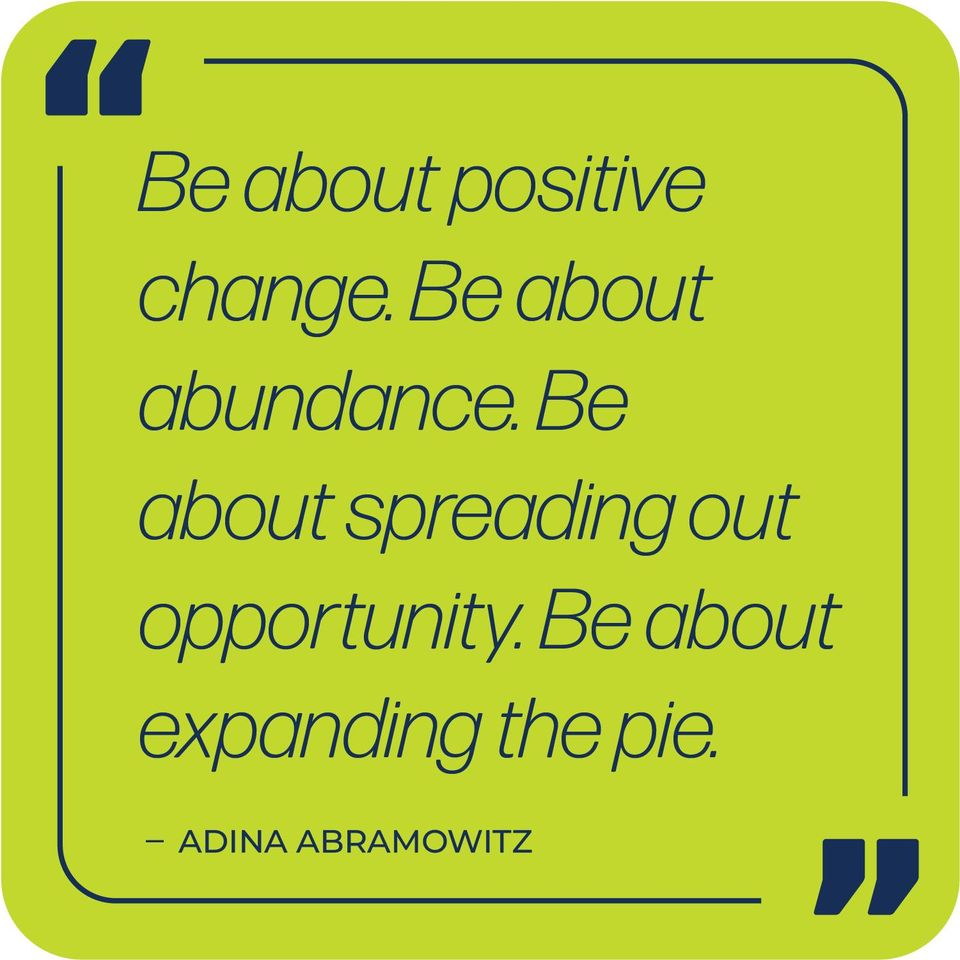
In 2018, Adina was contacted by her former colleague Mark Pinsky to help with a project in Bloomington, IN, which became the 1st CDFI Friendly city and helped form the CDFI Friendly strategy. After years of working with individual CDFIs, Adina enjoys how working at CDFI Friendly America has given her a fresh perspective—seeing and trying to solve for all of the credit needs in underserved communities. We at CDFI Friendly America are very grateful to have access to her wisdom and experience. Her advice to anyone entering the Community Development Finance space, "Be about positive change. Be about abundance. Be about spreading out opportunity. Be about expanding the pie."


Monday, March 6, 2023

Purim 5783/2023


Happy Purim!

This year we have raised over $1000 towards to split between charities who feed people. One is in our neighborhood, the Germantown Community Fridge. The other supports low-income women in need of assitance procuring Passover provisions, the Female Hebrew Benevolent Society.

The baskets are made of coconut fiber. They are used as liners for hanging plants, but you can really use them just as a bowl or basket. If you're not finding a use for them, just give yours back. We can use them again next year!

The lace is fairtrade, from a company that went out of business, sadly, and we were able to purchase them at steep discount. Irish nuns originally taught the women of this community in India to make lace. Machine-made lace tanked their business but they did revive it.

Sheila Erlbaum's crane

Thanks to all who worked on this project, one of the most joyful of the year:

Bakers:

Phyllis Berman, Jane Century, Fredi Cooper, Dayle Friedman, Pesha Leichter, Ruth Loew, Jennifer Paget, Sharon Strauss, and Esther Wiesner

Contributors of contents:

Lynne Jacobs, Irene McHenry, and Sharon Strauss.

Origami artists: Eleanor Brownstein and Sheila Erlbaum

Assemblers and Deliverers:

Eleanor Brownstein, Chana Dickter, Grace Flisser, Lynne Jacobs, Sharon Strauss & Sonia Voynow

Captain: Betsy Teutsch

                                            Eleanor demonstrating how the origami frogs jump.


Friday, October 21, 2022

Dorshei Derekh Overview 2022

Deborah Schwartzman's
parochet
Minyan Dorshei Derekh (“Path Seekers”) launched in 1986 as one of the three davening (prayer) groups meeting on Shabbat morning at Germantown Jewish Centre (GJC).

We are based in the Maslow Auditorium on the second floor of the school building. Shabbat services begin at 10:00 am and conclude around 12:30 pm followed by a kiddush/schmooze.

Dorshei Derekh is an affiliate of Reconstructing Judaism - we count faculty, students, and alumni among our membership. (As part of GJC, we are also an affiliate of the United Synagogue for Conservative Judaism.)

Ñ Core Dorshei Derekh ValuesÐ

·         Lay leadership

·         Vibrant participatory services

·         Critical and creative engagement with Torah and liturgy

·         Theological diversity

·         Mutual aid/caring for one another

·         Feminist innovation

·         LGBTQ inclusion

·         Anti-racist learning and practice

·         Intergenerational community

·         Inclusion of those who have been historically marginalized in Jewish communities

Ñ Davening Ð

·  We use Kol Haneshamah, Reconstructing Judaism’s prayerbook; many members of our minyanhelped to create it.

·   The first half of our service is enhanced by lively singing and/or chanting, occasionally accompanied by rhythm instruments.

·     We read Torah on a Triennial Torah cycle, divided into 3 aliyot.

·   Members volunteer to prepare and give each week’s Dvar Torah. These are text-based, creative, and intellectually stimulating presentations, encouraging lively response. Zoom participants participate in their own breakout groups following the Davar Torah.

Ñ LeadershipÐ

We rely on our members’ educational, liturgical, and organizational contributions to keep our minyan running.

Our leadership consists of the Chair, the past Chair, and the Incoming Chair. Individuals organize the many functions that are required to keep our minyan going. They are listed at www.minyandorsheiderekh.org

Ñ Service Times Ð

We meet on Saturday mornings and on Rosh Hashanah, Kol Nidre, Yom Kippur, Sukkot (1st day), Erev Simchat Torah, Shemini Atzeret/Simchat Torah, Purim Eve, Pesach (1st and 7th day).

We have joint davening with the other GJC minyanim for:

·         Kabbalat Shabbat
(Friday evening services)

·         Erev Rosh Hashanah

·         Charry Scholar-in-Residence Weekend

·         Occasional celebrations of Bar and Bat Mitzvahs and special events

Ñ Membership Ð

For minyan membership information contact Heather Shafter at heathershafter@verizon.net

For GJC membership information, contact Nina Peskin, GJC Executive Director, at

215-844-1507 Ext. 12 or director@germantownjewishcentre.org.


Monday, September 19, 2022

Dorshei Derekh Allocates 10% of Our Surplus for Tsedakah: Elul 2022

We have accumulated a surplus, a nice challenge for a small group like ours. We've decided that in Elul, we will donate 10% of our surplus. This initiative was hatched and shepherded by Lynne Jacobs. Thanks, Lynne! Jennifer Paget and myself, Betsy Teutsch, joined the group. It's an experiment; the minyan will revisit in the future.

Here are our five tsedakah allocations for Elul 2022:

Family Promise of Philadelphia   in honor of Rachel Falkove's retirement, formerly the Philadelphia Interfaith Hospitality Network.  

The Welcoming Center  in support of Afghan refugees. We are so wowed by the work that our members Naomi Klayman and Debbie Stern are doing GJC-wide. The Welcoming Center is the fiscal sponsor for the GJC initiative helping resettle our Afghan family.

Donors Choose in support of Philadelphia schools in need - this funds specific teacher requests.

Female Hebrew Benevolent Society  in support of emergency financial aid for Jewish women in crisis. The FHBS is over 200 years old!

Jerusalem African Community Center in support of African asylum seekers in Israel in Jerusalem, where our alum Ari Brochin works.


Sunday, August 7, 2022

On Pinchas - Jane Century, D’var Torah for Dorshei Derekh


by Jane F. Century

Thank you for the opportunity to mine some of the many nuggets of wisdom that today’s parshat Pinchas has to offer us. 

In the interests of full disclosure, I need to preface my comments by saying that prior to this moment, I have given exactly one d’var Torah in my entire life, at the start of last month’s quarterly minyan meeting -- so I hope you will allow me some additional latitude with this one.   I also confess I am something of a spiritual omnivore, so you may find me referencing things outside the pale of the usual Jewish commentaries.

By way of additional background, I am the middle child in a family with a sister one year older than me and a brother three and half years younger than me. 

We grew up in suburban Minneapolis, where all three of us got bussed to after-school Hebrew school for five years from 3rd grade to 7th grade, to a place that was very broadly satirized by the Cohen brothers, who grew up there as well, in their movie A Serious Man.

My family was firmly middle class.  After my parents undertook the expense of celebrating a bat mitzvah and luncheon for my older sister when she turned 13 and knowing that my brother’s bar mitzvah would be coming around the bend in a few short years, my mother came to me privately when the time for my own bat mitzvah was approaching and asked me if I really wanted one.

I didn’t need a flash card to know what the right answer to that was. 

If I agreed to take one for the team, my mom promised they would throw me a lavish Sweet 16 party when the time came instead. 

I’m afraid you’ll have to wait for another d’var to find out how that went.

Back to Pinchas, which brings together four seemingly disparate stories with one common theme having to do with legacy. For me, this parsha speaks to two profound concepts: the legacies we hope to pass along to those who survive us, and the ways in which all of us leave unfinished business in our wake.

The first example of legacy in this parsha is the legacy granted by God to Pinchas, the grandson of Mose’s elder brother Aaron, after he slays a high-ranking Israelite official and the Midianite princess with whom he was publicly consorting. 

Pinchas kills them both, and by this act, he simultaneously atones for and halts a period of rampant idol worship and the terrible plague that arose in the wake of it

In gratitude, God grants Pinchas a covenant of peace, and the eternal covenant of kehunah for his zeal in atoning for the children of Israel.  In doing so, he elevates Pinchas - along with all his descendants to the role of priest.

Before that moment, only Aaron and his descendants where designated by God as Kohanim.  By blessing Pinchas in this way, God extends the number of those who will inherit the honor and weight of a priestly connection to the divine.  

This is special legacy has continued to be passed down through the millennia from fathers to sons to this very day, indeed to this very room in which we sit.

The second legacy noted in this parsha is the one that results when God commands Moses to undertake yet another census, the aim of which will be to allocate future shares of the promised land in perpetuity in proportion to the total number of men aged 20 and older in each of their fathers’ tribes.

While all this counting and divvying is taking place, the action moves to a third story related to legacy in the parsha – one that marks something of radical step for its time, in which the five orphaned daughters of Tzelophehad realize that in the wake of their father’s death, they have no way to claim their own fair share of the inherited wealth that property ownership would confer upon the men of their generation when they reach the promised land. 


At this time, women without brothers were excluded from inheriting property when their father died, a system that continues in many places in the world where women still struggle to be counted as equals. We can also see its echoes in the racist practices of redlining that not only denied certain categories of citizens the right to own their own homes but the chance to build and pass on the wealth that such home ownership could generate for their descendants. 


At the time of Moses, women were effectively prevented from inheriting their own family land, with all that implied for their own financial autonomy and freedom to enter into marriage agreements. These five brave women stood before Moses, Eleazer and the chieftains at the Tent of Meeting, and basically asked to be counted. 


Moses brought their case before God who promptly agreed that Tzelophehad's daughters have “indeed spoken justly” and instructed Moses that in future, “If a man dies and has no son, you shall transfer his inheritance to his daughter.”


This brings us to the fourth and for me the most powerful example of legacy in the parsha as the people draw close to the Promised Land, in which God abruptly informs Moses he will not be allowed to enter.  The reason for this, we learn earlier, is that after the death of Moses’ older sister Miriam and the disappearance of Miriam’s well that had quenched the thirst of the Hebrew people throughout their wanderings in the desert, God instructed Moses to gather all the people crying out for water and bring forth water as he had done once before, this time by speaking to the rock.  Instead, Moses grows angry at the people for their ingratitude and hits the rock with his staff in frustration, unleashing not only water - but God’s ire.  Clearly, this was not the demonstration of a faith that God had in mind, and he makes Moses take the fall for it.

When we reflect on all that Moses experienced in one lifetime, it is hard to fathom what emotions must have passed through him on hearing that in one moment of anger he had forfeited his long-sought dream of entering the land of milk and honey.

That after a life that began with floating up to Pharoah’s daughter in a reed basket, being raised among royalty only to flee for his life after killing an Egyptian soldier he saw beating an enslaved fellow Jew, settling elsewhere to create a family for 40 years, speaking to God via a burning bush that he needs to prepare for the Exodus from Egypt, after repeated pleadings with Pharoah, after frogs, lice, vermin, etc, after the parting of the Red Sea and getting to the other side, after reminding people again and again that, unlike toilet paper, the supply chain of manna is infinite, so there is no need to hoard it, after carrying down Tablets 1.0, only to be greeted by the sight of a Golden Calf, and going back for Tablets 2.0, after beating back hordes of poisonous snakes with his own healing snake that becomes a symbol of healing to this day, and after responding again and again to the people’s seemingly endless doubts, misgivings and complaints, after all of this ardor and tzuris, it seems hard to conceive that Moses himself would be granted nothing more than a sneak peek from the top of Mount Abarim at the legacy others would inherit by dint of all his efforts on their behalf. 

Of all the people we meet in the Torah, Moses has the most direct, intimate experience with the Divine Presence across his long lifetime. He never serves as king.  Although he is the youngest in his family, I see him as the ultimate middle child between God and the people Israel and a skillful cajoler of both. He is also a prophet, a teacher and a devoted leader - of followers who do not always follow, who are mostly loyal, until they are not.

There are so many lessons to his legacy, we can barely count them.  And yet after everything he had done, after running the final lap of a grueling 40-year marathon of Biblical proportions, Moses suddenly learns - not only will he be prevented from crossing the finish line, but he won’t even live to set foot on the other side of it.  Instead, he will soon be gathered up with his siblings in the world to come and buried by God in an unmarked grave.

Moses later begs God in vain to give him a second chance to experience the “good land on the other side of the Jordan” when this same moment is recapitulated in Deuteronomy. But in this earlier parsha, when he is confronted with the chilling finality of God’s words, to his credit, he doesn’t hesitate.  He immediately opts to take one for the team.  His heart steps right up -- yet again -- to a place of compassion for his people, to urging God to replace him in a timely fashion, lest the people wander about like sheep without a shepherd.  And it is Joshua who will step into his shoes, rather than either of his own two sons. 

Beyond the themes of legacy, this parsha also speaks to two notions of time.  One is cyclical and the other linear.  The Jewish calendar binds us to countless cycles of recurring days and prayers rejoicing in everything from waking up in the morning to vanquishing our ancient enemies, days for grieving the loss of a loved one and for atoning for the prior year’s transgressions. Days in which we savor the miracle of each returning season of planting, flourishing and harvesting. 

We reconnect with all these recurring touchstones throughout the year like those cylindrical prayer wheels that hang in Tibetan monasteries that the monks reach out and spin as they pass while reciting their prayers.  Around and around we go through Rosh Hashana to Purim to Pesach to Shavuous and back.

But Mose’s life was a linear story.  For Moses, time stretched out like a Torah scroll that would only be unrolled – and never wound back to the beginning and repeated anew - except by all of us who inherited his legacy.

And tragically, for me at least, I feel we are witnessing in this present moment a foreshadowing of an age of non-recurrence that is unfolding before our very eyes, the legacy of humanity’s profound and shameful degradation and dismantling of the living web of land, sea and sky, which is already bringing an end to certain familiar cycles of migrations and seasons that our planet has witnessed over eons.

In the face of obvious signs of glacial melt and mass species extinction, we can no longer delude ourselves that the natural cycles and rhythms of recurrence we once relied upon as children will continue in our lifetimes. 

And here is where I’d like to take a big step sideways for a moment and take you on an imaginative journey by way of the ancient book of divination, the I Ching, the Chinese Book of Change, that some say dates back more than 5000 years, the source of which is said to be a divine oracle.  It is a book that fascinated the psychotherapist Carl Jung throughout his life. It is intended to be used as way of characterizing the essential nature of this very moment in time in which the person consulting it finds themselves. Consulting the I Ching can yield one or more of 64 possible responses or hexagrams.  Each has a name.  Interestingly Number 63 is called “After the End,” but the very last chapter, Number 64 is called “Before the End.”

I was struck recently by how closely the language of “Before the End” mirrors the literal and psychological moment of Moses reaching Mount Abarim and resonates powerfully with how we understand ourselves as we approach the completion of a long sought goal. 

I ask your indulgence in letting me read this passage and ask you to imagine Moses standing reading this to himself:

BEFORE THE END

“The accomplishment of a goal is in sight. It appears that long-impending matters may be brought to fruition with an acceptable amount of effort. Increasing clarity surrounds the meaning of situations once thought to be obscure. At the time of BEFORE THE END there is great promise for the future. A unique and sage viewpoint is present in human affairs. Order can be brought to chaotic situations.

“Because you are now unusually familiar with the elements involved in the object of your inquiry, you can evaluate and arrange them in whatever way necessary to achieve your aim. It should be a relatively simple matter to bring together groups of people in social or public-minded situations. By penetrating the psyche of each individual involved, you can arrange to gratify their needs within the group mechanism and thereby gain their co-operation.

“Yet, it would be a mistake to imagine that by achieving your aim you will bring matters to a close, that good judgment and order will prevail.

“The time BEFORE THE END can be compared to a lengthy trek over a high mountain. At some point, before reaching the peak, you can see in detail exactly how much farther you must travel.

“You will know what is involved in reaching the top because of your experience in the climb so far. However, when you do reach the peak, which has been in your sight for many long days of effort, you will have done only that.

“You will have acquired little information and no experience whatsoever about descending the other side. To rush up and over the top in an overly confident manner could bring disaster.

“In this passage The Book of Change warns at some length, of the dangers of proceeding without caution immediately BEFORE THE END. You must prepare yourself with wariness and reserve. The coming situation will be strange to you in every way, unlike any that you have experienced. In the near future you will not be able to draw upon the wealth of your acquired experience, for in many ways the time will be nothing short of a rebirth. The idea of rebirth here is a key to the meaning of the I Ching as a whole. The book ends with a new beginning, cycling back to the first hexagram, CREATIVE POWER, forever and ever into eternity.”  [Source:  The I Ching Workbook by R.L. Wing, December 19, 1979]

In this parsha, we stand as witnesses with Moses as he reaches both the pinnacle of his life and its end, calling us to imagine how we might feel if we stood in his shoes on Mount Abarim. The word Abarim means “passage.”  Is this moment a tragedy or a passage to a new era?  

Or as Mitch Albom, author of Tuesdays with Morrie, might say “All endings are also beginnings. We just don't know it at the time.”

My questions for you:

1.     How do you yourself feel about the legacy of Moses and the way his journey ends?  Do you see it as tragic, as appropriate, as a necessary evil or as creating space for a rebirth?


2.     How much of your own identity and life pursuit is wrapped up in what you hope to leave behind as a legacy?


3.     In what ways, if any, have you prepared yourself for the massive changes in our environmental, political, and economic lives that signal things may never cycle back in our lifetimes to where they were before?